Decoding the Cultural Fabric

The Golden Thread: Five Centuries of the Lyon Silk Manufacture

Cover Image

Prologue: The Incantation of the Lyon Weavers

On the banks of the Saône, in the heart of Lyon, where the damp air often became the inventor’s enemy, a drama unfolded that would later be hailed as the bedrock of industrial capitalism. The 18th-century Lyon Fabrique was not merely a coalition of guilds, but a gargantuan engine that transmuted raw foreign thread into a fabric more precious than gold. Yet, beneath this opulence lurked a genuine “curse” for capital: the traditional drawloom.

Toiling at such a loom resembled an exhausting, occult ritual. The master weaver controlled the shuttle, while his assistant—the drawboy (or drawgirl, usually a woman or a child)—literally hung above the structure upon a wooden frame. The working day of this “living component” spanned from 12 to 14 hours in stifling, humid workshops. Their task was physically punishing: to manually tug at hundreds of drawcords, lifting the warp for each individual pass of the shuttle.

For manufacture owners, this process was a logistical nightmare. Exhausted child assistants constantly blundered the intricate sequences, generating flaws that were impossible to rectify. The error rate was so staggering that resetting a loom for a new pattern consumed anywhere from three to eight weeks. This “human factor” rendered figured silk an unattainable luxury, bottlenecking the expansion of Western capital into markets dominated by the cheap, hand-woven textiles of the East. The world stood still, awaiting a technomage capable of forging iron order out of the chaos of human movement.

Chapter 1. The Jacquard Matrix: The First Digital Hardware

In 1804, Joseph-Marie Jacquard stepped onto the stage of the Industrial Revolution not merely as a weaver, but as a true engineering “hacker.” He did not create his invention in a vacuum; instead, he executed a brilliant intellectual synthesis, assembling the scattered “nodes” of his predecessors whose designs had faced decades of failure.

The Detective Line of an Intellectual Hack:

  • The Trace of Basile Bouchon (1725): Bouchon, the son of an organ maker, was the first to attempt using a perforated paper tape to control the loom’s needles. His concept was poetic, but the paper tore easily in the damp climate of the workshops, and the number of controlled threads remained minuscule.

  • The Trace of Jean-Baptiste Falcon (1728): Bouchon’s assistant replaced the fragile paper tape with a chain of sturdy cardboard punch cards. This allowed for the creation of long, non-repeating patterns, yet the system still required a human operator to manually present each card to the mechanism.

  • The Trace of Jacques de Vaucanson (1745): The master of automata fully automated the process by mounting the mechanism atop the loom and utilizing an iron cylinder. However, his machine was overly complex, prohibitively expensive, and mathematically constrained: the number of holes on the cylinder was fixed, which prohibited the creation of intricate figured designs.

Jacquard “broke” these limitations by merging the durability of Falcon’s cardboard chains with Vaucanson’s automated architecture. He engineered an elegant system of linkages where a single press of the weaver’s foot pedal simultaneously rotated the cylinder, pressed the card against the needle bed, and lifted the required threads.

Cover Image

Binary Code as Magic: The essence of Jacquard’s “matrix” lay in pure binary logic, predating electronic computers by over a century. The mechanics operated on a fundamental principle: a needle hitting the cardboard meant state 0 (the thread remains stationary); a needle passing through a hole meant state 1 (the thread is lifted). It was the materialization of abstract information into physical form.

The ramifications were magical: the loom’s productivity surged twentyfold. Now, a single person could perform the labor of an entire crew, producing fabrics of astonishing resolution—even woven portraits that contemporaries routinely mistook for fine engravings. Jacquard had created the world’s first programmable hardware, igniting a chain reaction that would soon lead to Babbage’s Analytical Engine and the total triumph of Western mechanized production.

Chapter 2. The British Spy Blockbuster and the Shadow of Babbage

While Lyon was immersing itself in the rhythmic roar of the revitalized Fabrique, across the English Channel, Britain—the “mistress of cotton”—observed the French triumph with a volatile mixture of envy and panic. This was an era of a genuine industrial thriller, where blueprints stood in for cannons, and algorithms were the territories ripe for conquest.

The Iron Curtain of Industry:

The British Empire, which had built its might upon the mechanization of cotton, was terrified of a French breakthrough in the silk industry. To safeguard its technological secrets, Britain enforced draconian measures: until 1843, a strict law prohibited the export of any machinery and tools. Furthermore, until 1825, skilled engineers and artisans were forbidden from emigrating under the threat of severe punishment. It was a true “technological autarky.”

Yet, under the cover of night, an “engineering transfer” was underway. Britain covertly dispatched spies to monitor the continent’s cutting-edge technologies. This operation involved smuggling blueprints, bribing French masters, and poaching specialists. This intellectual espionage birthed an analytical paradox: despite all the legislative walls, by 1832, approximately 600 Jacquard looms were already operating in England, both covertly and legally. The French binary code leaked through British ports like water through a sieve.

An Encounter with a Prophet: Charles Babbage’s Epiphany

In the mid-1830s, the English mathematician and inventor Charles Babbage—the man hailed as the “father of the computer”—visited Lyon. There, he acquired an artifact that would alter the history of computing forever: the famous woven silk portrait of Joseph-Marie Jacquard.

Cover Image

This artifact represented the pinnacle of contemporary techno-magic: it had been brought to life using 24,000 punch cards. The portrait possessed such an astonishing image resolution that guests in Babbage’s salon routinely mistook it for a fine engraving, until they approached it closely to witness the intricate interlacing of the threads.

Cover Image
Charles Babbage's Difference Engine. Designed for the automatic calculation of tables through rigid mechanics, it lacked flexible programming. Only after his epiphany in Lyon and his introduction to Jacquard’s punch cards did Babbage take a step forward to design his ultimate masterpiece—the universal Analytical Engine.

To Babbage, this was not merely art—it was a proof of concept. He arrived at a fundamental conclusion: if a sequence of holes in cardboard could guide the intricate pattern of a fabric, it could just as easily govern abstract mathematical operations. The Jacquard loom became the mirror in which his “Analytical Engine” was conceived.

Textiles Give Birth to Cybernetics:

Babbage directly borrowed Jacquard’s punch card system to feed programs into his computational giant. He even divided the architecture of his machine into nodes that carried distinct textile analogies:

  • The “Mill”—the analogue of the modern central processing unit (CPU), where operations were executed.

  • The “Store”—the analogue of random-access memory (RAM), where results were preserved in the positions of brass gear wheels.

His collaborator, Ada Lovelace, brilliantly formulated this connection in 1843:

“The Analytical Engine weaves algebraic patterns just as the Jacquard loom weaves flowers and leaves.”

Babbage himself explicitly acknowledged his debt to the textile genius of Lyon in his writings:

“The system of cards, invented by Jacquard, is the means by which we can transmit to a perfectly ordinary loom the command to weave any pattern... Availing myself of this same beautiful invention, I have similarly transmitted through my Calculating Engine the command to compute any formula, no matter how complex it may be.”

The British “spy trail” of copying Jacquard looms culminated in an unexpected finale: the West did not merely learn to manufacture silk faster; it learned to “weave” logic itself. The shadow of Babbage, which emerged from the punch cards of Lyon weavers, signaled the beginning of the end for the epoch where man served as the primary “processor” of information. The world began its transition from mechanical gears toward digital horizons.

Chapter 3. Hacking the System: Patents vs. Community (The Grande Fabrique)

While Britain was constructing its industrial empire upon the tenets of rugged individualism, Lyon engineered a unique economic anomaly—a collective innovation system that, in its core logic, mirrored modern Open Source. It was a clash between two jurisprudential universes: the aggressive British patenting regime and the Lyonnese model of “shared code.”

Two Models of Code Ownership:

  • The British Model: Here, an invention was a private fortress. A patent granted an absolute monopoly, which ignited endless litigation wars over intellectual property and bottlenecked the rapid dissemination of technology among small-scale artisans.

  • The Lyonnese Model (Grande Fabrique): The municipal authorities and the guild of Lyon viewed inventions as a public good. Instead of granting an inventor an exclusive monopoly, the city utilized a dedicated fund—the Caisse du droit des étoffes étrangères (established as early as 1711)—to buy out the rights to new technologies. Once acquired, the invention became community property: blueprints and physical models were deposited at the guild’s headquarters, where any local master could examine and implement them within their own workshop.

The Jacquard Drama: An Inventor Without a Patent

The emergence of the Jacquard mechanism in 1804 marked the zenith of this “socialist” mechanics. Joseph-Marie Jacquard found himself at the center of a dramatic conflict: his invention was effectively nationalized by the state in exchange for a government pension and a royalty of 50 francs for each operational loom.

Jacquard never held an individual patent for his signature invention during his Lyon period, a circumstance that later manifested as a personal tragedy. The municipality effectively “locked” the inventor within the city lines to prevent the technology from leaking to foreign competitors. When Jacquard lost his pension and his quarters at the Palais Saint-Pierre in 1813, he wrote with bitter resentment that due to the lack of a patent, his machine was being cloned by everyone, yet he derived no income from it:

“The city of Lyon is the sole beneficiary of my genius.”

Ethical Conflict and “Sabotage”:

The deployment of these looms triggered fierce techno-rebellions. Weavers, terrified by the specter of displacement, targeted the machinery. It was during this era that the term “sabotage” gained prominence: enraged artisans hurled their wooden shoes (sabots) directly into the mechanisms to shatter the delicate needles and cords.

Yet, it was the open-source nature of the technology that ultimately rescued the city. Because Jacquard’s “code” was accessible to all, Lyon managed to lightning-fast modernize thousands of looms—scaling from a mere 41 machines in 1811 to 1,879 by 1820. This secured Lyon a global monopoly on hyper-complex patterns that Britain remained unable to replicate for decades.

Macroeconomic Upshot: The Concentration of Capital

Cover Image

Notwithstanding this “democratic” access to technology, the economic denouement proved ruthless. Automation and the prohibitive maintenance costs of the new systems catalyzed a radical concentration of capital. By 1855, thirteen premier firms in Lyon already commanded 43% of the total output, and by 1867, this narrow elite had captured 57% of the market.

Established family dynasties, such as the Payens and the Baboins, channeled investments into synthetic chemical dyes and full-scale mechanization. In doing so, they mutated the Lyonnese Fabrique from a commonwealth of independent artisans into a gargantuan capitalist engine, mobilizing for the ultimate struggle for global market dominance.

Chapter 4. The Great Divergence: How the Punch Card Bled the East

For centuries, the East loomed as an impregnable economic fortress. China and India were heavily fortified behind a “Great Wall” built from millions of exceptionally cheap and masterfully skilled hands. Western capital routinely shattered against this barrier: European manufactures simply could not compete on price with Indian muslin or Chinese silk, because the cost of labor in the West was prohibitively high. Yet, it was precisely this financial pressure—the phenomenon of high “silver wages” in Britain and the Netherlands—that served as the detonator for a technological explosion.

A Macroeconomic Detective Story: The Logic of Weaponized Automation

By the 1770s, British silver wages towered six times higher than those in India. For British engineers, automation became not merely a strategic preference, but an act of ruthless survival. While the rock-bottom wages of the East stifled any incentive for invention (labor was far too cheap to be replaced with iron), the West was backed into a corner, forced to engineer binary hardware.

The Jacquard loom and British spinning machinery fundamentally altered the mathematics of the global marketplace. Driven by automation, labor productivity in Britain skyrocketed 6.53 times by 1820, whereas in the East, it stagnated at medieval baselines. A fatal inflection point occurred: the unit labor cost in the West dropped below that of the East, despite the astronomical wages of European workers. The binary code of Jacquard’s punch card effectively neutralized the centuries-old advantage of millions of Indian weavers, transforming their virtuosic skills into a technological anachronism.

Economic Shockwaves and the Geopolitical Assassination of Craft

The ramifications proved catastrophic. The mechanized textiles of the West launched an expansion that resembled a military invasion far more than commercial trade. While in the 18th century Britain operated as a net importer of Indian fabrics, by the 1830s, British muslin had become cheaper than native Indian muslin within India itself! The market share of British textiles in India aggressively escalated from a meager 3.9% in 1831–1835 to a crushing 58.4% by 1880.

This systematic deindustrialization of the East was heavily reinforced by colonial violence. In Bengal, the British replaced a market-driven procurement network with a system of direct coercion and impunity. Weavers were stripped of their commercial freedom, forcibly compelled to labor for prices fixed far below market rates, which functionally liquidated the Indian handloom sector by the mid-19th century.

The Tragic Reversal: The East as a Raw Material Appendage

When devastating silkworm epidemics (such as pébrine and flacherie) ravaged European raw silk production in the 1850s, the West made no attempt to rehabilitate the Eastern finished-goods sector. Instead, it systematically refashioned China and Japan into raw material appendages, importing exclusively raw silk to feed the hungry Jacquard looms of Lyon and Manchester. The East, which had once dictated global textile paradigms and fashion, was relegated to supplying cocoons to fuel Western algorithms.

The Paradox of Self-Preservation: The Punch Card as a Digital Weapon

At the dawn of the 20th century (most notably during the Nanjing Decade of 1927–1937), China mounted a desperate campaign to reclaim its economic sovereignty. Chinese entrepreneurs began aggressively procuring Jacquard looms from Europe and Japan. This was by no means a chase for immediate profit margins—manual labor in China remained demonstrably cheaper than operating machinery. It was a calculated, ideological mandate: deploying Western technology to forge a “National Spirit.”

Cover Image

The Paradox of Self-Preservation:

Chinese silk mills, such as the famous Du Jinsheng factory, began weaving intricate silk portraits of global leaders and grand national landscapes. They weaponized Jacquard hardware as an instrument of national self-preservation and anti-colonial resistance. The East arrived at a sobering realization: to survive in the world of the Great Divergence, one had to achieve absolute mastery over the very code that had once bled it dry.

Epilogue: Lessons of the Binary Tree

The history of the Jacquard loom is not merely a chronicle of the textile industry; it is a philosophical parable about information becoming flesh. For centuries, the human mind sought the “universal code” of existence. We remember the tragic fates of 16th-century occultists such as John Dee and Edward Kelley, who attempted to “hack the system” of the universe using Enochian magic and Kabbalistic ciphers.

Their path culminated in ruin: a plundered Mortlake, betrayal, exile, and Kelley’s fatal plunge from a castle tower in Prague in his pursuit of egocentric might. Their code was abstract, severed from matter, and engineered solely to serve the individual self.

In stark contrast, the “practical magic” of Joseph-Marie Jacquard and the Lyonnese artisans was stripped of occult hubris, yet saturated with the ethical purity of labor. Their binary code—a straightforward sequence of holes and voids in cardboard—did not attempt to summon angels; its sole purpose was to lift the warp thread to create a tangible, physical good.

The Great Divergence manifested because the West successfully mobilized information to serve capital. The West triumphed over the East not due to intellectual superiority, but because Jacquard’s punch card materialized abstract logic into an industrial force. While alchemists sought gold in retorts, the weavers of Lyon engineered a form of “digital iron” that rendered silk cheaper than Indian textiles, dismantled the centuries-old monopolies of the East, and ignited the flywheel of global capitalism.

The paramount lesson of the “binary tree” is that technology alters the world only when it is deeply rooted in reality. The Jacquard loom became the ancestor of the computer not in the silence of academic offices, but amidst the roar of weaving mills, where every strike of the shuttle marked a step toward the digital era. It was a victory of the collective mind of the Grande Fabrique over individual ego. Today, in the age of AI, we must remember: the true power of code lies not in its complexity, but in its capacity to serve humanity, weaving the very fabric of our shared life.


Bibliography

  • Allen, Robert. The British Industrial Revolution in Global Perspective. Cambridge University Press, 2009.

  • Broadberry, Stephen & Gupta, Bishnupriya. The Early Modern Great Divergence: Wages, Prices and Economic Development in Europe and Asia, 1500-1800. University of Warwick, 2005.

  • Broadberry, Stephen & Gupta, Bishnupriya. Cotton Textiles and the Great Divergence: Lancashire, India and Shifting Competitive Advantage, 1600-1850. LSE Department of Economic History, 2005.

  • Essinger, James. Jacquard’s Web: How a Hand-Loom Led to the Birth of the Information Age. Oxford University Press, 2004.

  • Langlois, Ganaele. “Distributed Intelligence: Silk Weaving and the Jacquard Mechanism.” Canadian Journal of Communication, Vol. 44, No. 4, 2019.

  • Siddique, Md. Safayet. “The Revolutionary Jacquard Loom: How It Invented Binary Code & Sparked the Digital Age.” 2026.

  • Pomeranz, Kenneth. The Great Divergence: China, Europe, and the Making of the Modern World Economy. Princeton University Press, 2000.

  • Pérez, Liliane. “Silk Fabrics in Eighteenth-century Lyon.” The Path Not Taken: French Industrialization in the Age of Revolution, 2007.

  • Starkova, Olha & Andreichikov, Oleksandr. “Intellectual capital of IT companies in the development processes of innovative technologies and digital transformations: Historical and genetic analysis.” Development Management, 2024.

  • Jongerius, Hella. Loom Room. Eindhoven University of Technology, 2023.

  • Drews, Juri-Apollo. The Gap & How to Bridge It: Attempts at Reconciling Weaving & Garment-Making. Master Thesis, EnsAD Paris, 2019.

  • TSA. “National Spirit & Modern technology. Modernizing Silk Production in Republican China.” TSA Conference, 2022.

  • Acemoglu, Daron & Johnson, Simon. Learning from Ricardo and Thompson: Machinery and Labor in the Early Industrial Revolution. MIT, 2024.

  • Wikipedia. Great Divergence (Great Divergence).

  • Mingei Project. Story of the Jacquard Invention.

  • Craftmark India. The Jacquard Loom: Technology and Process.

  • Suenson, Espen. How Computer Programmers Work – Understanding Software Development in Practise. PhD Thesis, Åbo Akademi, 2015.

  • Millet, Audrey. The Factory of Desire. Textiles and Techniques (Nineteenth to Twenty-First Centuries). Brepols, 2024.

  • Fletcher, Garth. Some Introductory Notes Concerning Jacquard Technology.

  • Distributed Design. Driving Design: Tech Humanism and the Commoning of Knowledge. 2023.

sys-sec: semantic-codes
Share:

Золота нитка: П’ять століть ліонської шовкової мануфактури

Cover Image

Пролог: Закляття Ліонських ткачів

На берегах Сони, у серці Ліона, де вологе повітря часто ставало ворогом винахідників, розгорталася драма, яку пізніше назвуть фундаментом промислового капіталізму. Ліонська «Fabrique» XVIII століття була не просто об’єднанням цехів, а гігантським механізмом, що перетворював сиру іноземну нитку на матерію, дорожчу за золото. Але за цим блиском ховалося справжнє «прокляття» для капіталу: традиційний тягловий верстат (drawloom).

Робота за таким верстатом нагадувала виснажливий окультний ритуал. Ткач-майстер керував човником, тоді як його помічник — drawboy (або drawgirl, зазвичай жінка чи дитина) — буквально висів над конструкцією на дерев’яній рамі. Робочий день цього «живого компонента» тривав від 12 до 14 годин у задушливих, вологих майстернях. Його завдання було фізично каральним: вручну смикати за сотні ниток (drawcords), піднімаючи основу (warp) для кожного окремого проходу човника.

Для власників мануфактур цей процес був кошмаром. Стомлені діти-помічники постійно помилялися в складних послідовностях, що призводило до появи браку, який неможливо було виправити. Рівень помилок був настільки високим, що підготовка верстата до нового візерунка тривала від трьох до восьми тижнів. Цей «людський фактор» робив візерунчастий шовк недосяжною розкішшю, стримуючи експансію західного капіталу на ринки, де панував дешевий ручний текстиль Сходу. Світ завмер у очікуванні техномага, який зможе перетворити хаос людських рухів на залізний порядок.

Розділ 1. Матриця Жакарда: Перше цифрове Hardware

У 1804 році Жозеф-Марі Жакард з’явився на сцені промислової революції не просто як ткач, а як справжній інженерний «хакер». Він не створював свій винахід у вакуумі; він здійснив геніальний інтелектуальний синтез, зібравши докупи розрізнені «вузли» своїх попередників, які десятиліттями зазнавали невдач.

Детективна лінія інтелектуального злом:

  • Слід Базіля Бушона (1725): Бушон, син органного майстра, першим спробував використати перфоровану паперову стрічку для керування голками верстата. Його ідея була поетичною, але папір рвався у вологому кліматі майстерень, а кількість керованих ниток була мізерною.

  • Слід Жана-Батіста Фалькона (1728): Асистент Бушона замінив крихку стрічку ланцюгом міцних картонних перфокарт. Це дозволило створювати довгі, неповторювані візерунки, але система все ще потребувала людини, яка б вручну підносила кожну карту до механізму.

  • Слід Жака де Вокансона (1745): Майстер автоматонів повністю автоматизував процес, встановивши механізм зверху верстата та використавши залізний циліндр. Проте його машина була занадто складною, дорогою і обмеженою математично: кількість отворів на циліндрі була фіксованою, що не давало створювати складні фігурні візерунки.

Жакард «зламав» ці обмеження, об’єднавши стійкість картонних ланцюгів Фалькона з автоматизованою архітектурою Вокансона. Він створив елегантну систему зв’язків, де рух ножної педалі ткача одночасно обертав циліндр, притискав карту до голкового ложа та піднімав потрібні нитки.

Cover Image

Двійковий код як магія: Суть «матриці» Жакарда полягала в чистій бінарній логіці, що на століття випередила електронні комп’ютери. Механіка працювала за принципом: голка впирається в картон — стан 0 (нитка стоїть), голка потрапляє в отвір — стан 1 (нитка піднімається). Це була матеріалізація абстрактної інформації у фізичну форму.

Наслідки були магічними: продуктивність верстата зросла у 20 разів. Тепер одна людина могла виконувати роботу цілої групи, створюючи тканини неймовірної роздільної здатності — аж до тканих портретів, які сучасники плутали з гравюрами. Жакард створив перше в світі програмоване залізо (hardware), запустивши ланцюгову реакцію, яка невдовзі призведе до появи аналітичної машини Беббіджа та тотальної перемоги західного машинного виробництва.

Розділ 2. Британський шпигунський блокбастер та тінь Беббіджа

Доки Ліон занурювався в ритмічний гуркіт оновленої «Fabrique», на іншому березі Ла-Маншу Британія, «володарка бавовни», спостерігала за французьким успіхом із сумішшю заздрості та паніки. Це був період справжнього промислового трилера, де замість гармат використовували креслення, а замість територій захоплювали алгоритми.

Залізна завіса промисловості:

Британська імперія, що збудувала свою могутність на механізації бавовни, панічно боялася французького прориву в шовковій індустрії. Для захисту своїх технологічних секретів Британія ввела драконівські заходи: до 1843 року діяв жорсткий закон про заборону експорту будь-якого обладнання та інструментів. Більше того, до 1825 року кваліфікованим інженерам та майстрам було заборонено емігрувати з країни під загрозою суворого покарання. Це була справжня «технологічна автаркія».

Проте під покровом ночі відбувався «інженерний трансфер». Британія таємно відправляла шпигунів для спостереження за передовими технологіями континенту. Відбувалася контрабанда креслень, підкуп французьких майстрів та переманювання фахівців. Цей інтелектуальний шпіонаж створив аналітичний парадокс: попри всі законодавчі стіни, у 1832 році в Англії вже таємно чи легально працювало близько 600 жакардових машин. Французький двійковий код просочився крізь британські порти, як вода крізь сито.

Зустріч з пророком: Епіфанія Чарльза Беббіджа

У середині 1830-х років англійський математик та винахідник Чарльз Беббідж, людина, яку називають «батьком комп’ютера», відвідав Ліон. Там він придбав річ, що назавжди змінила історію обчислень — знаменитий тканий шовковий портрет Жозефа-Марі Жакарда.

Cover Image

Цей артефакт був вершиною техно-магії того часу: він був створений за допомогою 24 000 перфокарт. Портрет мав таку неймовірну роздільну здатність (image resolution), що гості в салоні Беббіджа часто плутали його з тонкою гравюрою, доки не підходили впритул і не бачили переплетення ниток.

Для Беббіджа це було не просто мистецтво — це був доказ концепції. Він зробив фундаментальний висновок: якщо послідовність отворів у картоні може керувати складним візерунком тканини, вона може так само керувати абстрактними математичними операціями. Жакардовий верстат став дзеркалом, у якому народилася його «Аналітична машина».

Cover Image
Різницева машина Чарльза Беббіджа (Difference Engine). Створена для автоматичного розрахунку таблиць за допомогою жорсткої механіки, вона ще не мала гнучкого програмування. Лише після епіфанії (прозріння) в Ліоні та знайомства з перфокартами Жакарда, Беббідж зробить крок уперед і спроєктує свій головний шедевр — універсальну Аналітичну машину.

Текстиль народжує кібернетику:

Беббідж прямо запозичив систему перфокарт Жакарда для введення програм у свій обчислювальний гігант. Він навіть розділив структуру свієї машини на вузли, що мали текстильні аналогії:

  • «Mill» (Млин) — аналог сучасного процесора (CPU), де виконувалися операції.

  • «Store» (Склад) — аналог оперативної пам’яті (RAM), де результати зберігалися у вигляді положень латунних зубчастих коліс.

Його соратниця, Ада Лавлейс, геніально сформулювала цей зв’язок у 1843 році:

«Аналітична машина ткатиме алгебраїчні візерунки точно так само, як жакардовий верстат тче квіти та листя».

Сам Беббідж у своїх записах прямо визнавав борг перед текстильним генієм Ліона:

«Система карт, винайдена Жакардом, — це засіб, за допомогою якого ми можемо передати абсолютно звичайному верстату наказ виткати будь-який візерунок... Користуючись цим самим прекрасним винаходом, я подібним чином передав через свою Обчислювальну машину наказ розрахувати будь-яку формулу, якою б складною вона не була».

Британський «шпигунський шлях» копіювання жакардових машин призвів до неочікуваного фіналу: Захід не просто навчився швидше виробляти шовк, він навчився «ткати» саму логіку. Тінь Беббіджа, що виросла з перфокарт ліонських ткачів, стала початком кінця епохи, де людина була головним «процесором» інформації. Світ почав перехід від механічних шестерень до цифрових горизонтів.

Розділ 3. Хакінг системи: Патенти проти Спільноти (Grande Fabrique)

Доки Британія вибудовувала свою промислову імперію на засадах жорсткого індивідуалізму, Ліон створив унікальну економічну аномалію — «колективну систему інновацій Janis», яка за своєю логікою нагадувала сучасний Open Source. Це було протистояння двох юридичних всесвітів: агресивного британського патентування та ліонської моделі «спільного коду».

Дві моделі володіння кодом:

  • Британська модель: Тут винахід був приватною фортецею. Патент надавав абсолютну монополію, що породжувало нескінченні судові війни за інтелектуальну власність та стримувало швидке поширення технологій серед дрібних майстрів.

  • Ліонська модель (Grande Fabrique): Ліонська муніципальна влада та гільдія розглядала винаходи як публічне благо. Замість надання винахіднику права на монополію, місто використовувало спеціальний фонд — «Caisse du droit des étoffes étrangères» (створений ще у 1711 році), щоб викуповувати права на нові технології. Винахід ставав власністю громади: креслення та моделі депонувалися в офісі гільдії, де будь-який майстер міста міг вивчити їх та впровадити у себе в майстерні.

Драма Жакарда: Винахідник без патенту

Поява жакардового механізму у 1804 році стала піком цієї «соціалістичної» механіки. Жозеф-Марі Жакард опинився у центрі детективної колізії: його винахід фактично став власністю держави в обмін на державну пенсію та роялті у розмірі 50 франків з кожного встановленого верстата.

Жакард ніколи не мав індивідуального патенту на свій головний винахід у ліонський період, що згодом стало для нього особистою трагедією. Муніципалітет фактично «заблокував» винахідника в місті, щоб запобігти продажу технології зовнішнім конкурентам. Коли у 1813 році Жакард втратив свою пенсію та житло в палаці Сен-П’єр, він з гіркотою писав, що через відсутність патенту його машину копіюють усі, але він не отримує з цього жодного доходу:

«Місто Ліон — єдиний бенефіціар мого генія».

Етичний конфлікт та «саботаж»:

Впровадження верстатів супроводжувалося справжніми техно-бунтами. Ткачі, залякані привидом безробіття, нищили машини. Саме тоді народився термін «саботаж»: розлючені майстри скидали свої дерев’яні черевики (sabots) прямо в механізми, щоб зламати тендітні голки та нитки.

Проте відкритість технології зрештою врятувала місто. Завдяки тому, що «код» Жакарда був доступним кожному, Ліон зміг блискавично модернізувати тисячі верстатів (з 41 машини у 1811 році до 1 879 у 1820-му). Це створило глобальну монополію Ліона на надскладні візерунки, які Британія ще довго не могла повторити.

Макроекономічний підсумок: Концентрація капіталу

Cover Image

Незважаючи на «демократичний» доступ до технологій, економічний фінал був суворим. Автоматизація та дорожнеча обслуговування нових систем призвели до радикальної концентрації капіталу. До 1855 року тринадцять провідних компаній Ліона вже контролювали 43% виробництва, а до 1867 року ця вузька еліта захопила 57% ринку.

Старі сімейні клани, такі як Пайєн (Payen) та Бабуан (Baboin), інвестували в хімічні барвники та механізацію, перетворюючи ліонську «Fabrique» з об’єднання ремісників на гігантську капіталістичну машину, яка готувалася до фінальної битви за світове панування.

Розділ 4. Велика Дивергенція: Як перфокарта знекровила Схід

Протягом століть Схід здавався нездоланною економічною фортецею. Китай та Індія були захищені «великим муром» із мільйонів надзвичайно дешевих і віртуозно кваліфікованих рук. Західний капітал розбивався об цю стіну: європейські мануфактури не могли конкурувати за ціною з індійським мусліном чи китайським шовком, бо вартість праці на Заході була занадто високою. Але саме цей фінансовий тиск — феномен високих «срібних зарплат» у Британії та Нідерландах — став детонатором технологічного вибуху.

Макроекономічний детектив: Логіка збройної автоматизації

До 1770-х років британська зарплата в срібному еквіваленті була у 6 разів вищою за індійську. Для британських інженерів автоматизація стала не просто вибором, а актом безжального виживання. У той час як низькі зарплати на Сході позбавляли стимулів до винахідництва (праця була надто дешевою, щоб її замінювати залізом), Захід був змушений створити двійкове hardware.

Жакардовий верстат та британські прядильні машини змінили саму математику глобального ринку. Завдяки автоматизації продуктивність праці в Британії до 1820 року зросла у 6,53 раза, тоді як на Сході вона стагнувала на середньовічному рівні. Стався фатальний перелом: вартість одиниці праці (unit labour cost) на Заході стала нижчою, ніж на Сході, попри захмарні зарплати європейців. Двійковий код перфокарти Жакарда нівелював багатовікову перевагу мільйонів індійських ткачів, перетворивши їхні навички на технологічний анахронізм.

Економічний удар та геополітичне вбивство ремесла

Наслідки були катастрофічними. Механізований текстиль Заходу почав експансію, яка більше нагадувала військове вторгнення. Якщо у XVIII століття Британія була імпортером індійських тканин, то до 1830-х років британський муслін став дешевше індійського у самій Індії! Частка британського текстилю на індійському ринку злетіла з мізерних 3,9% у 1831-35 роках до нищівних 58,4% у 1880-му.

Процес деіндустріалізації Сходу був підкріплений колоніальним насильством. У Бенгалії англійці замінили ринкову систему закупівель системою прямого примусу та імпанітету. Ткачі втратили свободу вибору; їх силоміць змушували працювати за цінами, що були значно нижчими за ринкові, що фактично призвело до руйнації індійського ручного сектору до середини XIX століття.

Трагічний реверс: Схід як сировинний придаток

Коли у 1850-х роках епідемії хвороб шовкопряда (пебріна та флашерія) знищили європейське виробництво сирцю, Захід не став відновлювати східну промисловість готових товарів. Навпаки, він перетворив Китай та Японію на сировинний придаток, імпортуючи виключно сирець для своїх жакардових машин у Ліоні та Манчестері. Схід, який колись диктував моду всьому світу, тепер лише постачав кокони для західних алгоритмів.

Парадокс самозбереження: Перфокарта як цифрова зброя

На початку XX століття (особливо в період Нанкінського десятиліття 1927–1937) Китай здійснив відчайдушну спробу повернути суверенітет. Китайські бізнесмени почали масово закуповувати жакардові верстати в Європі та Японії. Це не було гонитвою за маржею — ручна праця в Китаї все ще залишалася дешевшою за машинну. Це був ідеологічний вибір: використання західної технології для створення «Національного духу».

Cover Image

Китайські фабрики (як-от «Ду Цзіньшен») почали ткати шовкові портрети світових лідерів та національні пейзажі, використовуючи жакардове hardware як засіб національного самозбереження та інструмент антиколоніальної боротьби. Схід зрозумів: щоб вижити у світі Великої Дивергенції, потрібно оволодіти кодом, який колись його знекровив.

Епілог: Уроки двійкового дерева

Історія жакардового верстата — це не просто літопис текстильної промисловості; це філософська притча про те, як інформація стає плоттю. Протягом століть людський розум шукав «універсальний код» буття. Ми пам’ятаємо трагічні долі окультистів XVI століття, таких як Джон Ді та Едвард Келлі, які намагалися «зламати систему» Всесвіту за допомогою енохіанської магії та кабалістичних шифрів.

Їхній шлях закінчився руїною: пограбований Мортлейк, зрада, вигнання та фатальне падіння Келлі з вежі в Празі в гонитві за єгоцентричною могутністю. Їхній код був абстрактним, відірваним від матерії, спрямованим на служіння власному «Я».

На противагу їм, «практична магія» Жозефа-Марі Жакарда та ліонських ремісників була позбавлена окультної гордині, але сповнена етичної чистота праці. Їхній двійковий код — проста послідовність отворів та пустот на картоні — не намагався викликати ангелів; він мав на меті підняти нитку основи, щоб створити реальне, фізичне благо.

Велика Дивергенція стала наслідком того, що Захід зумів перевести інформацію на службу капіталу. Захід переміг Схід не через інтелектуальну зверхність, а тому, що перфокарта Жакарда матеріалізувала абстрактную логіку в промислову силу. Поки алхіміки шукали золото в ретортах, ткачі Ліона створили «цифрове залізо», яке зробило шовк дешевшим за індійський текстиль, зруйнувало вікові монополії Сходу та запустило маховик глобального капіталізму.

Головний урок «двійкового дерева» полягає в тому, що технологія лише тоді змінює світ, коли вона вкорінена в реальність. Жакардовий верстат став предком комп’ютера не в тиші кабінетів, а в гуркоті ткацьких цехів, де кожен удар човника був кроком до цифрової ери. Це була перемога колективного розуму «Grande Fabrique» над індивідуальним его. Сьогодні, в епоху ШІ, нам варто пам’ятати: справжня сила коду не в його складності, а в його здатності служити людству, створюючи тканину нашого спільного життя.


Список використаної літератури

  1. Allen, Robert. The British Industrial Revolution in Global Perspective. Cambridge University Press, 2009.

  2. Broadberry, Stephen & Gupta, Bishnupriya. The Early Modern Great Divergence: Wages, Prices and Economic Development in Europe and Asia, 1500-1800. University of Warwick, 2005.

  3. Broadberry, Stephen & Gupta, Bishnupriya. Cotton Textiles and the Great Divergence: Lancashire, India and Shifting Competitive Advantage, 1600-1850. LSE Department of Economic History, 2005.

  4. Essinger, James. Jacquard’s Web: How a Hand-Loom Led to the Birth of the Information Age. Oxford University Press, 2004.

  5. Langlois, Ganaele. “Distributed Intelligence: Silk Weaving and the Jacquard Mechanism.” Canadian Journal of Communication, Vol. 44, No. 4, 2019.

  6. Siddique, Md. Safayet. “The Revolutionary Jacquard Loom: How It Invented Binary Code & Sparked the Digital Age.” 2026.

  7. Pomeranz, Kenneth. The Great Divergence: China, Europe, and the Making of the Modern World Economy. Princeton University Press, 2000.

  8. Pérez, Liliane. “Silk Fabrics in Eighteenth-century Lyon.” The Path Not Taken: French Industrialization in the Age of Revolution, 2007.

  9. Starkova, Olha & Andreichikov, Oleksandr. “Intellectual capital of IT companies in the development processes of innovative technologies and digital transformations: Historical and genetic analysis.” Development Management, 2024.

  10. Jongerius, Hella. Loom Room. Eindhoven University of Technology, 2023.

  11. Drews, Juri-Apollo. The Gap & How to Bridge It: Attempts at Reconciling Weaving & Garment-Making. Master Thesis, EnsAD Paris, 2019.

  12. “National Spirit & Modern technology. Modernizing Silk Production in Republican China.” TSA Conference, 2022.

  13. Acemoglu, Daron & Johnson, Simon. Learning from Ricardo and Thompson: Machinery and Labor in the Early Industrial Revolution. MIT, 2024.

  14. Wikipedia. Great Divergence (Великое расхождение).

  15. Mingei Project. Story of the Jacquard Invention.

  16. Craftmark India. The Jacquard Loom: Technology and Process.

  17. Suenson, Espen. How Computer Programmers Work – Understanding Software Development in Practise. PhD Thesis, Åbo Akademi, 2015.

  18. Millet, Audrey. The Factory of Desire. Textiles and Techniques (Nineteenth to Twenty-First Centuries). Brepols, 2024.

  19. Fletcher, Garth. Some Introductory Notes Concerning Jacquard Technology.

  20. Distributed Design. Driving Design: Tech Humanism and the Commoning of Knowledge. 2023.


sys-sec: semantic-codes
Share:

Industrial Espionage and Closed Source: How Jacquard Cards Became the First Software Worth Stealing

Cover Image
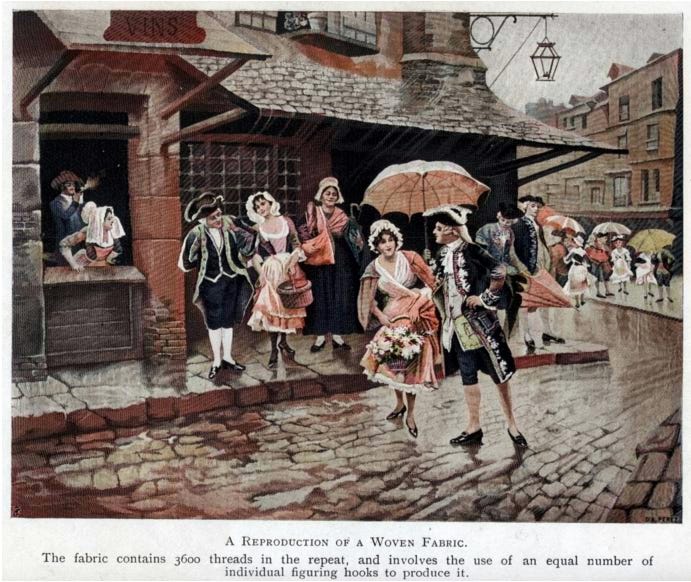
Woven street scene (frontispiece of F. Bradbury's book, 1912), created on a Jacquard loom using 3,600 hooks. The result of history's first tangible software.

The Silicon Valley of the 19th Century

When we speak of software today, our imagination instantly conjures images of sterile offices, the glow of monitors, and invisible streams of data coursing through silicon microchips. However, the true digital era was born not in 20th-century California, but a century and a half earlier—amidst the deafening roar of weaving looms in Lyon, France. It was there, surrounded by the scent of raw silk and machine oil, that the world’s first High-Tech market emerged, and intellectual property first became detached from its physical medium.

The world’s first binary code was tangible: it was not stored in the “cloud” but punched into thick cardboard. This was an era when the first hackers, industrial spies, and pirates did not hide behind anonymous proxy servers, but wore top hats, frock coats, and wielded magnifying glasses, attempting to crack the “closed source code” of their competitors.

To understand the scale of this technological revolution, a direct parallel with modernity must be drawn. In this ecosystem, the complex weaving loom itself was the Hardware—a powerful mechanism, yet dead without instructions. A deck of Jacquard punch cards served as the Software—proprietary program code written in the language of binary logic (”0” for no hole, “1” for a hole). Meanwhile, the final, incredibly complex pattern on the silk or tapestry—ranging from portraits to intricate floral designs—was nothing less than the user interface (UX/UI), the visual manifestation of the algorithm’s execution.

The central intrigue of our investigation lies in how ordinary “holey cardboard” suddenly became the most expensive currency of the Industrial Revolution. Developing a single, complex “Jacquard program” required a colossal investment in R&D: from commissioning prominent artists to months of mathematical calculations performed by “weaving programmers” (mise en carte masters). The cost of one such deck could equal the value of a small house; its theft meant instant wealth for the pirate and financial ruin for the creator.

In this article, we will uncover the detective story of how Lyon’s master silk weavers built the first “restricted-access facilities” around their looms, implemented physical equivalents of NDAs, and designed hardware encryption that rendered stolen software useless without knowing the architecture of the “hardware.” This is the story of history’s first battle for data, where the stakes were not just silk threads, but the right to own the digital future.

Chapter 1: Anatomy of the First Software (The Technical Foundation)

When we speak of software today, our imagination typically conjures rows of code on a flickering monitor or complex silicon microchips. Yet, a century and a half before the first electronic computers emerged, a fully functional digital software, punched into thick cardboard, already existed in Lyon, France. To understand why these “holey cards” became the target of the world’s first cyberwars and industrial espionage, we must dissect the internal architecture of this ingenious mechanical system.

1. The Binary Logic of the Thread: Tangible Code

At the core of Jacquard technology lies pure, uncompromising binary logic, which Lyon weavers used daily decades before George Boole formalised it. As Gareth Fletcher notes, the Jacquard machine functions as a delicate signal amplifier: it translates the reading of the presence or absence of a hole into a powerful physical movement capable of lifting a taut thread.

The operating principle of the system relies on the ironclad logic of mechanical selection:

  • State “1” (Hole Present): A horizontal sensing pin passes through a hole in the card. This allows a vertical hook to remain engaged with the knives of the moving lifting frame (griffe). As the frame rises, it lifts the warp thread, forming a weft pattern on the face of the fabric.

  • State “0” (No Hole): The pin strikes the solid cardboard and is pushed back. This mechanical impulse deflects the hook away from the knife. The frame rises empty, the hook remains in place, and the thread does not participate in forming the pattern.

This was the world’s first physical binary code, where every bit of information had a tangible manifestation as a hole in a paper medium.

2. “Database” Architecture and Mechanical Clock Speed

If an individual punch card represents a single line of code, their accumulation formed a complex data architecture. Nineteenth-century Jacquard machines managed arrays ranging from 100 to over 1,000 hooks simultaneously. In the context of modern IT, this means a single card served as a line of 175-bit, 400-bit, or even 1,344-bit code.

The design features of this “database” are remarkably sophisticated:

  • Endless Chain: Individual cards were laced together with specialized cords (card lacing) into a continuous loop—a “deck.” This allowed the program to run cyclically, automatically repeating the pattern report without operator intervention.

  • Clock Speed: Each pass of the shuttle carrying the weft thread was essentially one clock cycle of the mechanical processor. The system operated with incredible reliability: modern analogues perform up to 420 million cycles per year, a workload that challenges the endurance of even modern hardware servers.

  • Bandwidth: To create a single complex tapestry or portrait, decks consisting of thousands of cards were deployed. For instance, Jacquard’s famous woven silk portrait was driven by “software” containing 24,000 punch cards.

3. Master Coders: Low-Level Programming via Assembler

Writing this primal software was a highly analytical process called mise en carte (card mapping). This was the precise historical equivalent of writing low-level code (Assembler or Machine Code), where the programmer works directly with the machine’s “registers”—the specific hooks and needles.

The process of creating a “program” unfolded in several distinct stages:

  • Point Paper (Calibrated Grid Paper): The artistic sketch was manually transferred onto a specialized grid. Each cell of this grid represented a pixel of the future data matrix. The master was effectively practicing raster graphics a century before the invention of monitors, where a filled cell denoted a logical one.

  • Piano Card Stamper: The world’s first mechanical data entry interface. It was a punch press equipped with heavy keys resembling those of a piano. Reading the “code” from the point paper, the punch operator pressed the keys, which activated the pins in a punch box, piercing holes into the cardboard.

  • Physical Debugging: Any error was critical. A “bug” in the form of a single extra or missed punch instantly became a defect in the fabric. Because the cards were laced into a chain, fixing a mistake required halting the entire production line, physically cutting out the “corrupted line of code,” punching a new card, and lacing it back in.


This meticulous work left no room for error, as the development cost of a single complex card deck could equal the value of a small house. Consequently, the profession of the Lyon “mapping programmer” was both the most lucrative and the most closely guarded secret of the era.

Chapter 2: The Economics of Lyon Silk and the Canuts’ “Golden Safes”

In 19th-century France, Lyon was not merely a city of weavers; it was the Silicon Valley of its day, where the silk industry operated as a high-tech market. The ultimate value in this business resided neither in the mechanical looms themselves nor in the stockpiles of raw materials, but in a unique algorithm—the pattern encoded into the punch cards. It was during this period that humanity first realized that information could be worth more than gold, and protecting it required the creation of the world’s first “restricted-access facilities.”

1. The Price of a Pattern: R&D Capital Investment

Developing a new fabric collection for the royal courts of Europe demanded colossal investments, which in modern terminology translates directly to Research and Development (R&D) costs. The process of “writing” a single complex pattern was prolonged and financially draining:

  • Design Sketching: First, prominent artists were paid exorbitant fees to capture the creative vision.

  • Mathematical Engineering: Next, a weaving programmer (the mise en carte master) spent months calculating every single thread intersection, mapping the sketch onto calibrated paper.

  • Software Production: In the final stage, a punch operator spent weeks manually piercing thousands of cardboard cards using scarce punch presses.

The total development cost of one such “Jacquard program” could easily equal the value of a small house. Yet, a successful “program” was a tremendous asset; if a pattern became the trend of the season, it secured the workshop with orders for years to come and generated astronomical profits.

2. “Closed Source” in Action: Physical Information Security

Driven by the critically high cost of development, the Lyon master silk weavers (Canuts) treated their punch cards exactly as modern IT giants treat the source code of Windows or iOS. As the historical essays of Philippe Desmules demonstrate, Lyon workshops operated under principles that shockingly mirror today’s Information Security protocols:

  • Safe-Chests: Decks of cards were never left on the looms after a shift. They were immediately dismantled, indexed, and locked inside heavy oak chests secured with multiple locks, the keys to which the owner always carried on his person.

  • Access Control: Workshops were often enclosed by high fences. External individuals, casual buyers, and even apprentices from other guilds were strictly forbidden from entering the premises.

  • Secrecy Regimes and NDAs: While executing confidential orders, windows facing the street were draped with thick fabric to prevent outsiders from spying on the rhythm of the lifting threads and visually reading the “code.” The weavers themselves took a guild oath of non-disclosure—a historical precursor to the NDA, violation of which meant total banishment from the profession.

3. Monopoly on Color and Form: The Fear of “Piracy”

The entire economic model of Lyon relied on strict guild secrets, as the Canuts were the first to grasp the danger of separating information from its physical medium. A master’s primary fear was that the code on the cards had become autonomous from the loom itself.

Theft or duplication of the mapping scheme meant that a pirate competitor could launch identical production on their own hardware the very next day. Without investing a single cent in artists or months of mathematical calculations, the “pirate” could dump prices, selling the identical fabric much cheaper. For the true author of the pattern, this meant instant financial ruin.

Effectively, the Lyon weavers created history’s first intellectual property protection system under conditions where data was still written on cardboard, and the binary code could be felt with one’s own hands.

Chapter 3: Methods of Espionage: From Bribery to “Reverse Engineering”

Because the development of each Jacquard deck demanded colossal intellectual and financial expenditures, Lyon transformed into a veritable cyberwarfare battlefield of the 19th century. Why waste months on the mathematical calculations of thread intersections and paying mise en carte masters when the “software” could simply be pirated? Competitors deployed a large-scale hunt for the Jacquard code, utilizing methods that today we would classify as classic hacker attacks.

1. Physical Theft (Direct Piracy)

The simplest yet riskiest method resembled modern special operations to steal industrial secrets. Since Jacquard decks for complex tapestries were exceptionally heavy and voluminous, smuggling them out unnoticed was nearly impossible.

However, spies frequently bribed impoverished apprentices who, for a fee, would covertly sneak a deck of punch cards out of the workshop for just one night. In pre-arranged secret laboratories, another master used quick stencils to duplicate the arrangement of the holes in the cardboard. Before dawn, the original “software” was discreetly returned to the owner’s loom, while the competitor walked away with a complete duplicate of the program, ready to be deployed on their own hardware.

2. Visual Hacking (Data Sniffing and Interception)

A more sophisticated method was visual espionage, which effectively served as a mechanical analogue to network traffic interception (data sniffing). Spies, masquerading as inspectors, raw material merchants, or wealthy foreign buyers, attempted to gain access directly to the L’Atelier du Canut (the weaver’s workshop).

A trained master or artist could observe a running loom for a few minutes, visually decoding:

  • The rhythmic movement of the Jacquard machine’s knives;

  • The sequence in which the warp threads rose;

  • The logic of card shifting on the cylinder.

Possessing phenomenal visual memory, they memorized and later sketched out these algorithms, attempting to replicate the logic of the code without ever touching the physical punch cards.

3. Reverse Engineering of the Finished Product (Decompilation)

This was the most intellectual and “legal” form of espionage, requiring no trespassing onto restricted facilities. Competitors simply purchased a cut of the new fabric from the market and subjected it to deep analysis—a process identical to the decompilation of a compiled binary file.

Drawing on principles later detailed by Ralph Griswold in his research on woven structures, spies disassembled the fabric “thread by thread” under powerful magnifying glasses. The process unfolded as follows:

  • Recording every intersection of the weft and warp threads;

  • Mapping the data as link matrices or binary arrays (0s and 1s);

  • Identifying the unit motif (the minimum repeating pattern);

  • Fully reconstructing the punch card scheme directly from the fabric structure.

4. Hardware Security: The Hidden Weapon of the “Iron”

However, as Fred Bradbury demonstrates in his seminal work, Jacquard Mechanism and Harness Mounting, even an flawlessly copied code often proved entirely useless due to a layer of hardware protection embedded directly into the machine’s architecture—the type of harness mounting.

The primary barrier was the physical orientation of the Jacquard machine:

  • London tie: The machine is mounted crosswise to the loom, with the card cylinder positioned at the side.

  • Norwich tie: The machine is mounted parallel to the length of the loom, with the cards hanging directly over the weaver’s head or behind them.

If a spy stole cards programmed for a London tie and attempted to run them on hardware configured with a Norwich tie, they obtained complete visual chaos. This happened due to a catastrophic data addressing mapping failure: turning the machine 90 degrees completely altered the physical placement of the hooks relative to the warp threads. Consequently, a “bit” of data attempted to lift a thread in an entirely different location than intended by the design.

This stands as history’s first instance of DRM (Digital Rights Management), where the software (the punch card) was inextricably bound to the geometry of the hardware. Attempting to “port” such code without completely rebuilding the harness mounting—which consisted of thousands of calibrated cords—was financially and technically impossible. In essence, the Canuts created hardware encryption that rendered stolen data mere “garbage” without the specific architectural knowledge of the target processor-loom.

Chapter 4: Consequences, “License Agreements,” and Mechanical Bugs

The war over the “closed source code” of Jacquard punch cards did not merely shift the balance of power in Lyon—it forged an entirely new legal and technological reality. Once information permanently detached itself from the physical loom and transformed into an autonomous commodity, humanity confronted challenges that today form the bedrock of digital civilization.

1. Litigation Wars and the Birth of Digital Law

The emergence of Jacquard cards forced the French authorities and Lyon guilds to completely rethink the very concept of property. Traditional laws protected tangible goods—a bolt of silk fabric—but proved utterly powerless against the duplication of an “algorithm” punched into cardboard.

  • Information as an Asset: These became the world’s first legal precedents where the law attempted to protect a sequence of logical signals rather than physical matter.

  • The Legal Shift: Guilds began drafting rules to regulate the ownership rights of punch card decks, effectively creating the historical prototypes of modern software license agreements.

2. The Canuts’ Weaving Riots (Rebellion Against Platforms)

The famous uprisings of the Lyon silk weavers (Canuts) in the 19th century are frequently romanticized as a Luddite struggle against machinery. However, drawing on the research of Philippe Desmules, these riots can be viewed through a different lens: they were history’s first rebellions against platform monopolization.

  • Protecting Intellectual Capital: The master weavers defended the rights to their unique code—their proprietary patterns and mathematical calculations—against absorption by large-scale manufacturers.

  • The Fight for Autonomy: They revolted against a system where the “platform owner” (the big capitalist) sought to dictate the terms of digital asset ownership, stripping the weaver-coder of control over their intellectual property.

3. Physical Vulnerabilities and the Mechanical Bugs of Cardboard

As Fred Bradbury’s technical analysis demonstrates, this primal physical software was highly vulnerable to environmental factors, generating bugs that remain intimately familiar to modern engineers.

  • Medium Deformation: Due to the high humidity inside weaving workshops, the thick paste-board expanded or contracted. This caused the cylinder to lose its alignment (strike square), preventing the needles from hitting the holes cleanly. This process is structurally identical to the appearance of bad sectors on modern hard drives.

  • Desynchronization and Data Loss: Wear and tear on the cords (card lacing) that bound the cards into a continuous chain caused timing desynchronization (out of synch). The machine attempted to read the code before the physical cycle had concluded, serving as a direct mechanical analogue to packet loss during data transmission.

  • Missed Punches and Bit-Flips: Mechanical failures or errors by the punch operator (missed punches) created scenarios where a logical one inverted into a zero. These early historical bit-flips demanded the deployment of physical hotfixes: halting the loom entirely, cutting out the corrupted card, and lacing a newly punched one back into the chain.

4. The Legacy: Passing the Torch from Jacquard to Babbage

This early struggle for code paved the way for the true computing revolution. A tectonic shift occurred when Jacquard technology caught the attention of the English mathematician Charles Babbage.

  • The Silk Eureka: Babbage was so profoundly struck by Jacquard’s woven silk portrait—executed via a deck of 24,000 punch cards—that he realized punched holes could encode abstract mathematical formulae just as easily as floral designs.

  • Weaving Algebra: Babbage integrated the Jacquard system into his Analytical Engine, prompting his famous observation: “The Analytical Engine weaves algebraic patterns just as the Jacquard loom weaves flowers and leaves.”

  • The First Algorithms: When Lady Ada Lovelace authored the foundational programs for Babbage’s engine, she deployed the exact logic of loops and conditional branching that Lyon mise en carte masters had been calculating on grid paper decades prior.

Conclusion: Why “Weaver’s Logic” Shifted the World to Digital

The history of industrial espionage in 19th-century Lyon proves a fundamental truth: information wars and the battle for data have always been waged, regardless of whether the code was punched into thick cardboard or stored in gigabytes of cloud servers. The moment humanity learned to separate the intellectual product (the algorithm) from the physical tool (the loom), this algorithm instantly transformed into the world’s most expensive currency.

Jacquard cards were far ahead of their time, becoming the first intellectual product to exist autonomously from the “hardware.” “Weaver’s Logic” proved so powerful and universal that it effortlessly outgrew the boundaries of the textile craft. Emerging from the humid workshops of Lyon, it passed through Babbage’s blueprints and Lovelace’s notes to lay the foundation for the first computers of the 20th century, ultimately shaping the digital space we inhabit today.

The world has changed, but the principles remain the same: those who own the code, own the future.

Primary Sources

  • Bradbury, F. Jacquard Mechanism and Harness Mounting. — Belfast: F. King & Sons Ltd., 1912. — 368 p.

  • Demoule, P. L’Atelier du canut lyonnais au XIXe siècle. — (Cited via “Updated Theses” and Lyon economic research materials).

  • Fletcher, G. Some Introductory Notes Concerning Jacquard Technology. — Mason, NH: JacqCAD International, 2002.

  • Fletcher, G. Importing Adobe Illustrator images into JacqCAD. — JacqCAD Co, 1998.

  • Griswold, R. E. Analysis of Weave Structures, Part 1: Introduction. — Tucson: University of Arizona, 2004.

  • Griswold, R. E. Analysis of Weave Structures, Part 2: A Canonical Form. — Tucson: University of Arizona, 2004.

  • Griswold, R. E. Designing Weave Structures Using Boolean Operations, Part 1. — Tucson: University of Arizona, 2002.

  • Griswold, R. E. From Drawdown to Draft — A Programmer’s View. — Tucson: University of Arizona, 2004.

Supplementary Literature

  • Boole, G. An Investigation of the Laws of Thought on which are Founded the Mathematical Theories of Logic and Probabilities. — 1854. (Reprint: Dover, 1973).

  • Oelsner, G. H. A Handbook of Weaves. — New York: Macmillan, 1915. (Reprint: Dover, 1952).

  • Barker, A. F., Midgley, E. Analysis of Woven Fabrics. — London: Scott, Greenwood & Son, 1914.

  • Fox, T. W. The Mechanism of Weaving. — London: Macmillan, 1894.

Software and Specifications

  • JacqCAD MASTER®. CAD program for Jacquard textile design.

  • WIF Specification (Weaving Information File).


Share:

Промислове шпигунство та закритий код: Як жакардові карти стали першим софтом, який намагалися викрасти

Cover Image
Тканий вуличний пейзаж (фронтиспис книги Ф. Бредбері, 1912 р.), створений на жакардовому верстаті за допомогою 3600 гачків. Результат роботи першого в історії матеріального софту.

Кремнієва долина XIX століття

Коли ми сьогодні говоримо про програмне забезпечення, наша уява миттєво малює стерильні офіси, мерехтіння моніторів та невидимі потоки даних, що пронизують кремнієві мікросхеми. Проте справжня цифрова ера народилася не в Каліфорнії XX століття, а на півтораста років раніше — під оглушливий гуркіт ткацьких верстатів у французькому Ліоні. Саме там, серед запаху сирого шовку та мастила, виник перший у світі ринок High-Tech, де інтелектуальна власність вперше відокремилася від фізичного носія.

Перший у світі двійковий код був матеріальним: він не зберігався у «хмарах», а був вибитий на цупкому картоні. Це була епоха, коли перші хакери, промислові шпигуни та пірати не ховалися за анонімними проксі-серверами, а носили циліндри, фраки й орудували лупами, намагаючись зламати «закритий код» конкурентів.

Для розуміння масштабу цієї технологічної революції варто провести пряму паралель із сучасністю. У цій екосистемі сам складний ткацький верстат був «залізом» (Hardware) — потужним, але мертвим без інструкцій механізмом. Колода жакардових перфокарт виступала як «софт» (Software) — проприєтарний програмний код, написаний мовою бінарної логіки («0» — немає отвору, «1» — є отвір). А фінальний, неймовірної складності малюнок на шовку чи гобелені — від портретів до квіткових орнаментів — був не чим іншим, як інтерфейсом користувача (UX/UI), візуальним втіленням роботи алгоритму.

Головна інтрига нашого дослідження полягає в тому, як звичайний «дірявий картон» несподівано став найдорожчою валютою епохи промислової революції. Створення однієї складної «жакардової програми» вимагало колосальних інвестицій у R&D: від оплати праці відомих художників до місяців математичних розрахунків «ткацьких програмістів» (майстрів mise en carte). Вартість однієї такої колоди могла дорівнювати вартості невеликого будинку, а її викрадення означало миттєве збагачення пірата та фінансовий крах автора.

У цій статті ми розкриємо детективну історію про те, як ліонські майстри-канути будували перші «режимні об’єкти» навколо своїх верстатів, впроваджували фізичні аналоги NDA та створювали апаратне шифрування, яке робило вкрадений софт марним без знання архітектури «заліза». Це розповідь про першу в історії битву за дані, де на кону стояли не просто шовкові нитки, а право на володіння цифровим майбутнім.

Розділ 1: Анатомія першого софту (Технічний базис)

Коли ми говоримо про програмне забезпечення, уява зазвичай малює рядки коду на мерехтливому моніторі або складні кремнієві мікросхеми. Проте за півтора століття до появи перших ЕОМ у французькому Ліоні вже існував повноцінний цифровий софт, вибитий на цупкому картоні. Щоб зрозуміти, чому ці «діряві картки» стали об’єктом перших у світі кібервійн та промислового шпигунства, необхідно розібрати внутрішню архітектуру цієї геніальної механічної системи.

1. Двійкова логіка нитки: Код, який можна помацати

В основі жакардової технології лежить чиста, безкомпромісна бінарна логіка, яку за десятиліття до Джорджа Буля вже щоденно використовували ліонські ткачі. Як зазначає Гарт Флетчер, жакардова машина працює як підсилювач делікатного сигналу: вона перетворює зчитування наявності чи відсутності отвору на потужний рух, здатний підняти натягнуту нитку.

Принцип роботи системи тримається на залізній логіці механічного вибору:

  • Стан «1» (Є отвір): Горизонтальна зчитувальна голка (sensing pin) проходить крізь отвір у карті. Це дозволяє вертикальному гачку (hook) залишитися в зачепленні з ножами рухомої рами (griffe). Коли рама йде вгору, вона піднімає нитку основи, формуючи візерунок утка на лицьовому боці тканини.

  • Стан «0» (Немає отвору): Голка впирається в картон і зсувається назад. Цей механічний імпульс відхиляє гачок від ножа. Рама піднімається порожньою, гачок залишається на місці, а нитка не бере участі у формуванні візерунка.


Це був перший у світі матеріальний двійковий код, де кожен біт інформації мав фізичне втілення у вигляді отвору на паперовому носії.

2. Архітектура «баз даних» та тактова частота механіки

Якщо окрема перфокарта — це один рядок коду, то їхня сукупність утворювала складну архітектуру даних. Жакардові машини ХІХ століття керували масивами від 100 до 1000 гачків одночасно. У контексті сучасних ІТ це означає, що одна карта була рядком 175-бітного, 400-бітного або навіть 1344-бітного коду.

Особливості цієї «бази даних» вражають своєю інженерною продуманістю:

  • Endless Chain (Нескінченний ланцюг): Окремі карти зв’язувалися спеціальними шнурами (card lacing) у безперервну петлю — «колоду». Це дозволяло програмі працювати циклічно, автоматично повторюючи рапорт візерунка без втручання оператора.

  • Тактова частота: Кожен прокид човника з ниткою утка був фактично одним тактом механічного процесора. Система працювала з неймовірною надійністю: сучасні аналоги здійснюють до 420 мільйонів циклів на рік, що ставить під загрозу витривалість навіть сучасних залізних серверів.

  • Пропускна здатність: Для створення одного складного гобелена чи портрета використовувалися колоди з тисяч карт. Наприклад, шовковий портрет Жакарда був написаний «софтом» із 24 000 перфокарт.

3. Майстри-кодери: Програмування на рівні Assembler

Написання цього первісного софту було аналітичним процесом, який називався mise en carte (листування карт). Це був точний історичний аналог написання коду низького рівня (Assembler або Machine Code), де програміст працює безпосередньо з «регістрами» — конкретними гачками та голками машини.

Процес створення «програми» відбувався у кілька етапів:

  1. Point Paper (Калібрований папір): Художній ескіз вручну переносився на спеціальну сітку. Кожна клітинка цієї сітки — це піксель майбутньої матриці даних. Майстер фактично займався растровою графікою за століття до появи моніторів, де зафарбована клітинка означала логічну одиницю.
  2.  Piano Card Stamper (Піано-машина): Перший у світі механічний інтерфейс введення даних. Це був прес із важкими клавішами, подібними до фортепіанних. Майстер-перфоратор, читаючи «код» із паперу, натискав клавіші, які приводили в дію штирі у коробці з пробійниками (punch box), вибиваючи отвори в картоні.
  3. Фізичний дебаггінг: Будь-яка помилка була критичною. «Баг» у вигляді одного зайвого або пропущеного отвору (missed punch) миттєво ставав дефектом на тканині. Оскільки карти були сплетені в ланцюг, виправлення помилки вимагало зупинки всього виробництва, фізичного вирізання «зіпсованого рядка коду», вибивання нової карти та її вплетення назад.
Ця філігранна праця не прощала помилок, адже вартість розробки однієї складної колоди карт могла дорівнювати вартості невеликого будинку. Саме тому професія ліонського «програміста-листувальника» була найбільш оплачуваною та найбільш охоронюваною таємницею епохи.

Розділ 2: Економіка ліонського шовку та «золоті сейфи» канутів

У Франції XIX століття Ліон був не просто містом ткачів — він був тогочасною Кремнієвою долиною, де шовкова індустрія відігравала роль ринку High-Tech. Головною цінністю в цьому бізнесі був не сам механічний верстат чи запаси сировини, а унікальний алгоритм — візерунок, закарбований у перфокартах. Саме в цей період людство вперше усвідомило: інформація може коштувати дорожче за золото, а її захист потребує створення перших у світі «режимних об’єктів».

1. Ціна візерунка: Капіталовкладення в R&D

Створення нової колекції тканин для королівських дворів Європи вимагало колосальних інвестицій, які в сучасній термінології називаються витратами на дослідження та розробку (R&D). Процес «написання» одного складного візерунка був тривалим та фінансово виснажливим:

  • Дизайн ескізу: Спочатку відомим художникам платили величезні гонорари за створення художнього образу.

  • Математичне проектування: Потім ткацький програміст (майстер mise en carte) протягом місяців вираховував кожне переплетення ниток, переносячи ескіз на калібрований папір.

  • Виробництво софту: На завершальному етапі майстер-перфоратор тижнями вручну вибивав тисячі картонних карт на дефіцитних пресах.

Загальна вартість розробки однієї такої «жакардової програми» могла дорівнювати вартості невеликого будинку. Проте вдала «програма» була справжнім активом: якщо візерунок ставав трендом сезону, він забезпечував майстерню замовленнями на роки вперед і приносив астрономічні прибутки.

2. «Закритий код» у дії: Фізична інформаційна безпека

Через критично високу вартість розробки ліонські майстри-канути (Canuts) ставилися до своїх перфокарт так само, як сучасні ІТ-гіганти до вихідного коду Windows чи iOS. Як свідчать історичні нариси Філіпа Демуля, ліонські майстерні функціонували за принципами, що вражаюче нагадують сучасні протоколи Information Security:

  • Скрині-сейфи: Колоди карт ніколи не залишали на верстатах після зміни. Їх негайно знімали, маркували та замикали у важкі дубові скрині-сейфи на кілька замків, ключі від яких власник завжди носив при собі.

  • Контроль доступу (Access Control): Майстерні часто обносили високими парканами. Стороннім особам, випадковим покупцям і навіть підмайстрам з інших цехів було суворо заборонено заходити на територію.

  • Режим таємниці та NDA: Під час роботи над секретними замовленнями вікна, що виходили на вулицю, завішували щільною тканиною, щоб ніхто не міг підглянути ритм підйому ниток і зчитати «код» візуально. Самі ткачі давали цехову клятву про нерозголошення — історичний аналог угоди NDA, порушення якої означало повне вигнання з професії.

3. Монополія на колір та форму: Страх перед «піратством»

Уся економічна модель Ліона трималася на суворих цехових таємницях, адже канути першими зрозуміли небезпеку відриву інформації від фізичного носія. Головний страх майстра полягав у тому, що код на картах став автономним від самого верстата.

Викрадення або копіювання схеми означало, що конкурент-пірат міг запустити аналогічне виробництво на своїх потужностях вже наступного дня. Не витративши жодної копійки на художників та місяці математичних розрахунків, «пірат» міг демпінгувати, продаючи ідентичну тканину значно дешевше, що означало миттєвий фінансовий крах для справжнього автора візерунка.

Фактично, ліонські ткачі створили першу в історії систему захисту інтелектуальної власності в умовах, коли сама «цифра» ще була паперовою, а бінарний код можна було помацати руками.

Розділ 3: Методи шпигунства: Від підкупу до «реверс-інжинірингу»

Оскільки розробка кожної жакардової колоди вимагала колосальних інтелектуальних та фінансових витрат, Ліон перетворився на справжнє поле кібервійни XIX століття. Навіщо витрачати місяці на математичні розрахунки переплетень та оплату праці майстрів mise en carte, якщо «софт» можна просто піратити? Конкуренти розгорнули масштабне полювання на жакардовий код, використовуючи методи, які сьогодні ми назвали б класичними хакерськими атаками.

1. Фізичне викрадення (Пряме піратство)

Найпростіший, але й найризикованіший метод нагадував сучасні спецоперації з викрадення промислових секретів. Оскільки жакардові колоди для складних гобеленів були надзвичайно важкими й об’ємними, винести їх непомітно було майже неможливо.

Проте шпигуни часто підкуповували бідних підмайстрів, які за певну плату таємно виносили колоду перфокарт з майстерні всього на одну ніч. У заздалегідь підготовлених таємних лабораторіях інший майстер за допомогою швидких трафаретів копіював розташування отворів у картоні. До світанку оригінальний «софт» непомітно повертався на верстат власника, а конкурент отримував повний дублікат програми, готовий до запуску на власних потужностях.

2. Візуальний злом (Sniffing та перехоплення даних)

Більш витонченим був метод візуального шпигунства, що фактично є механічним аналогом перехоплення мережевого трафіку (data sniffing). Шпигуни під виглядом інспекторів, торговців сировиною або багатих іноземних покупців намагалися потрапити безпосередньо до L’Atelier du Canut (майстерні канута).

Тренований майстер або художник міг протягом декількох хвилин спостерігати за роботою верстата, візуально зчитуючи:

  • Ритм руху ножів жакардової машини;

  • Послідовність підйому ниток основи;

  • Логіку зміни карт на циліндрі.

Маючи феноменальну зорову пам’ять, вони запам’ятовували та пізніше замальовували ці алгоритми, намагаючись відтворити логіку коду без доступу до самих перфокарт.

3. Реверс-інжиніринг готового продукту (Декомпіляція)

Це був найбільш інтелектуальний та «легальний» вид шпигунства, який не вимагав проникнення на закриті об’єкти. Конкуренти просто купували відріз нової тканини на ринку й піддавали його глибокому аналізу, що ідентично декомпіляції готового бінарного файлу.

Спираючись на принципи, які пізніше детально описав Ральф Грізволд у своїх працях з аналізу ткацьких структур, шпигуни розбирали тканину «по ниточці» під сильними лупами. Процес виглядав так:

  • Фіксація кожного пересічення ниток утка та основи;

  • Запис даних у вигляді матриць зв’язків або бінарних масивів (0 та 1);

  • Визначення unit motif (мінімального повторюваного малюнка);

  • Повне відновлення схеми пробивки перфокарт на основі структури тканини.

4. Апаратний захист: Секретна зброя «заліза»

Проте, як доводить Фред Бредбері у своїй праці «Jacquard Mechanism and Harness Mounting», навіть ідеально скопійований код часто виявлявся абсолютно марним через апаратний захист, «зашитий» у саму архітектуру верстата — тип прив’язку жгута (Harness Mounting).

Головним бар’єром була орієнтація жакардової машини:

  • London tie (Лондонська прив’язка): машина встановлюється поперек верстата, а циліндр з картами розташований збоку.

  • Norwich tie (Норвічська прив’язка): машина паралельна довжині верстата, карти звисають над головою ткача або позаду.

Якщо шпигун викрадав карти, розраховані під London tie, і запускав їх на залізі з Norwich tie, він отримував повний візуальний хаос. Це відбувалося через порушення адресації даних (Mapping): оскільки при зміні орієнтації машини на 90 градусів повністю змінювалося фізичне розташування гачків (hooks) відносно ниток основи, «біт» інформації намагався підняти нитку зовсім не в тому місці, де це було передбачено дизайном.

Це був перший в історії випадок DRM (Digital Rights Management), де софт (перфокарта) був нерозривно пов’язаний з геометрією заліза. Спроба «портувати» такий код без повної перев’язки жгута, що складається з тисяч каліброваних кордів, була фінансово та технічно неможливою. Фактично, канути створили апаратне шифрування, яке робило вкрадені дані «сміттям» без знання архітектури конкретного процесора-верстата.

Розділ 4: Наслідки, «ліцензійні угоди» та механічні баги

Війна за «закритий код» жакардових перфокарт не просто змінювала баланс сил у Ліоні — вона створювала абсолютно нову правову та технологічну реальність. Коли інформація остаточно відокремилася від верстата й перетворилася на самостійний товар, людство вперше зіткнулося з викликами, які сьогодні складають основу цифрової цивілізації.

1. Судові війни та зародження цифрового права

Поява жакардових карт змусила французьку владу та ліонські гільдії переглянути саму концепцію власності. Традиційні закони захищали фізичний товар — сувій тканини, але вони виявилися безсилими проти копіювання «алгоритму», закарбованого в дірочках на картоні.

  • Інформація як актив: Це були перші у світі прецеденти, де закон намагався захистити не матерію, а послідовність логічних сигналів.

  • Юридичний зсув: Гільдії почали розробляти правила, що регулювали право на володіння колодами перфокарт, фактично створюючи прототипи сучасних ліцензійних угод на програмне забезпечення.

2. Ткацькі бунти канутів (Повстання проти платформ)

Знамениті повстання ліонських ткачів-канутів у XIX столітті часто сприймають як боротьбу проти машин. Проте, спираючись на дослідження Філіпа Демуля, їх можна побачити під іншим кутом: це були перші повстання проти монополізації платформ.

  • Захист інтелектуального капіталу: Майстри-канути захищали право на свій унікальний код — власні візерунки та математичні розрахунки — від поглинання великими фабрикантами.

  • Боротьба за автономію: Вони виступали проти системи, де «власник платформи» (великий капіталіст) намагався диктувати умови володіння цифровими розробками, позбавляючи кодера-ткача контролю над його інтелектуальною власністю.

3. Фізичні вразливості та механічні баги картону

Як доводить технічний аналіз Фреда Бредбері, цей перший матеріальний софт був надзвичайно вразливим до впливу фізичного світу, що породжувало баги, знайомі сучасним інженерам.

  • Деформація носія: Через вологість у ткацьких цехах цупкий пастовий картон (paste-board) розширювався або звужувався. Це призводило до того, що циліндр втрачав точність удару (strike square), і голки не потрапляли в отвори. Це ідентично появі пошкоджених секторів (bad sectors) на сучасних дисках.

  • Десинхронізація та втрата даних: Знос шнурів (card lacing), якими карти зв’язувалися в ланцюг, викликав десинхронізацію таймінгів (out of synch). Машина намагалася зчитати код раніше, ніж завершився фізичний цикл, що є прямим аналогом втрати пакетів (packet loss) при передачі даних.

  • Needles missing та Bit-flips: Механічні збої або помилки майстра-перфоратора (missed punches) створювали ситуації, коли логічна одиниця перетворювалася на нуль. Ці перші в історії bit-flips вимагали випуску фізичних «патчів» (hotfixes): повної зупинки верстата, вирізання зіпсованої карти та вплетення нової.

4. Спадщина: Естафета від Жакарда до Беббіджа

Ця боротьба за код підготувала підґрунтя для справжньої обчислювальної революції. Тектонічний зсув стався, коли жакардова технологія потрапила в поле зору англійського математика Чарльза Беббіджа.

  • Шовкова еврика: Беббідж був настільки вражений шовковим портретом Жакарда, створеним за допомогою 24 000 перфокарт, що зрозумів: картонні отвори можуть кодувати не лише квіти, а й абстрактні формули.

  • Ткання алгебри: Беббідж запозичив жакардову систему для своєї Аналітичної машини, залишивши знамениту цитату: «Аналітична машина тче алгебраїчні візерунки точно так само, як жакардовий верстат тче квіти та листя».

  • Перші алгоритми: Леді Ада Лавлейс, пишучи програми для машини Беббіджа, використовувала ту саму логіку циклів та розгалужень, яку ліонські майстри mise en carte вираховували на папері в клітинку за десятиліття до неї.

Висновок: Чому «Логіка ткача» перевела світ на цифру

Історія промислового шпигунства в Ліоні ХІХ століття доводить фундаментальну істину: інформаційні війни та боротьба за дані велись завжди, незалежно від того, чи зберігався код на дірявому картоні, чи в гігабайтах хмарних сховищ. Щойно людство навчилося відокремлювати інтелектуальний продукт (алгоритм) від фізичного інструмента (верстата), цей алгоритм миттєво перетворився на найдорожчу валюту світу.

Жакардові карти випередили свій час, ставши першим інтелектуальним продуктом, що існував автономно від «заліза». «Логіка ткача» (Weaver’s Logic) виявилася настільки потужною та універсальною, що легко переросла рамки текстильного ремесла. Вийшовши з вологих ліонських цехів, вона через креслення Беббіджа та нотатки Лавлейс заклала фундамент для перших комп’ютерів XX століття, зрештою сформувавши той цифровий простір, у якому ми живемо сьогодні.

Світ змінився, але принципи залишилися тими самими: той, хто володіє кодом, володіє майбутнім.


Основні джерела

  1. Bradbury, F. Jacquard Mechanism and Harness Mounting. — Belfast: F. King & Sons Ltd., 1912. — 368 p..

  2. Demoule, P. L’Atelier du canut lyonnais au XIXe siècle. — (Цит. за: «Оновлені тези» та матеріалами дослідження економіки Ліона).

  3. Fletcher, G. Some Introductory Notes Concerning Jacquard Technology. — Mason, NH: JacqCAD International, 2002..

  4. Fletcher, G. Importing Adobe Illustrator images into JacqCAD. — JacqCAD Co, 1998..

  5. Griswold, R. E. Analysis of Weave Structures, Part 1: Introduction. — Tucson: University of Arizona, 2004..

  6. Griswold, R. E. Analysis of Weave Structures, Part 2: A Canonical Form. — Tucson: University of Arizona, 2004..

  7. Griswold, R. E. Designing Weave Structures Using Boolean Operations, Part 1. — Tucson: University of Arizona, 2002..

  8. Griswold, R. E. From Drawdown to Draft — A Programmer’s View. — Tucson: University of Arizona, 2004..

Допоміжна література (згадана в джерелах)

  1. Boole, G. An Investigation of the Laws of Thought on which are Founded the Mathematical Theories of Logic and Probabilities. — 1854. (Reprint: Dover, 1973).

  2. Oelsner, G. H. A Handbook of Weaves. — New York: Macmillan, 1915. (Reprint: Dover, 1952).

  3. Barker, A. F., Midgley, E. Analysis of Woven Fabrics. — London: Scott, Greenwood & Son, 1914..

  4. Fox, T. W. The Mechanism of Weaving. — London: Macmillan, 1894..

Програмне забезпечення та специфікації

  1. JacqCAD MASTER®. CAD program for Jacquard textile design..

  2. WIF Specification (Weaving Information File)..


Share:

Popular Posts

Powered by Blogger.

Recent Posts

© 2026 The Weaver's Logic. All rights reserved. | Privacy Policy