


 |
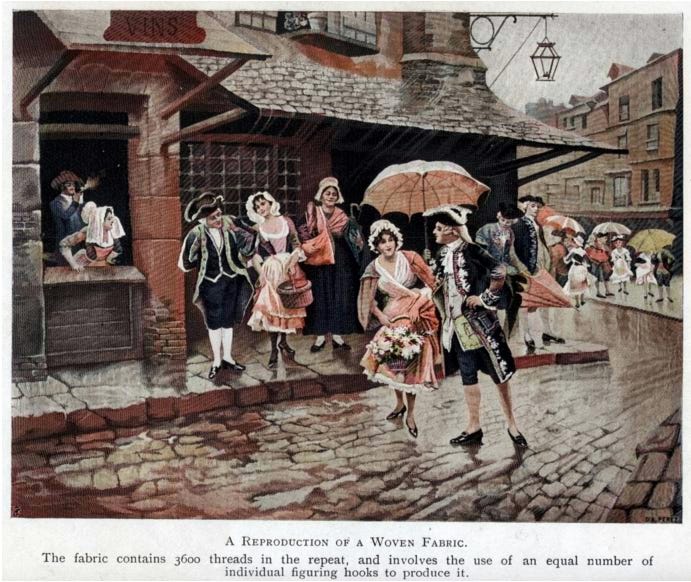
| Woven street scene (frontispiece of F. Bradbury's book, 1912), created on a Jacquard loom using 3,600 hooks. The result of history's first tangible software. |
The Silicon Valley of the 19th Century
When we speak of software today, our imagination instantly conjures images of sterile offices, the glow of monitors, and invisible streams of data coursing through silicon microchips. However, the true digital era was born not in 20th-century California, but a century and a half earlier—amidst the deafening roar of weaving looms in Lyon, France. It was there, surrounded by the scent of raw silk and machine oil, that the world’s first High-Tech market emerged, and intellectual property first became detached from its physical medium.
The world’s first binary code was tangible: it was not stored in the “cloud” but punched into thick cardboard. This was an era when the first hackers, industrial spies, and pirates did not hide behind anonymous proxy servers, but wore top hats, frock coats, and wielded magnifying glasses, attempting to crack the “closed source code” of their competitors.
To understand the scale of this technological revolution, a direct parallel with modernity must be drawn. In this ecosystem, the complex weaving loom itself was the Hardware—a powerful mechanism, yet dead without instructions. A deck of Jacquard punch cards served as the Software—proprietary program code written in the language of binary logic (”0” for no hole, “1” for a hole). Meanwhile, the final, incredibly complex pattern on the silk or tapestry—ranging from portraits to intricate floral designs—was nothing less than the user interface (UX/UI), the visual manifestation of the algorithm’s execution.
The central intrigue of our investigation lies in how ordinary “holey cardboard” suddenly became the most expensive currency of the Industrial Revolution. Developing a single, complex “Jacquard program” required a colossal investment in R&D: from commissioning prominent artists to months of mathematical calculations performed by “weaving programmers” (mise en carte masters). The cost of one such deck could equal the value of a small house; its theft meant instant wealth for the pirate and financial ruin for the creator.
In this article, we will uncover the detective story of how Lyon’s master silk weavers built the first “restricted-access facilities” around their looms, implemented physical equivalents of NDAs, and designed hardware encryption that rendered stolen software useless without knowing the architecture of the “hardware.” This is the story of history’s first battle for data, where the stakes were not just silk threads, but the right to own the digital future.
Chapter 1: Anatomy of the First Software (The Technical Foundation)
When we speak of software today, our imagination typically conjures rows of code on a flickering monitor or complex silicon microchips. Yet, a century and a half before the first electronic computers emerged, a fully functional digital software, punched into thick cardboard, already existed in Lyon, France. To understand why these “holey cards” became the target of the world’s first cyberwars and industrial espionage, we must dissect the internal architecture of this ingenious mechanical system.
1. The Binary Logic of the Thread: Tangible Code
At the core of Jacquard technology lies pure, uncompromising binary logic, which Lyon weavers used daily decades before George Boole formalised it. As Gareth Fletcher notes, the Jacquard machine functions as a delicate signal amplifier: it translates the reading of the presence or absence of a hole into a powerful physical movement capable of lifting a taut thread.

The operating principle of the system relies on the ironclad logic of mechanical selection:
State “1” (Hole Present): A horizontal sensing pin passes through a hole in the card. This allows a vertical hook to remain engaged with the knives of the moving lifting frame (griffe). As the frame rises, it lifts the warp thread, forming a weft pattern on the face of the fabric.
State “0” (No Hole): The pin strikes the solid cardboard and is pushed back. This mechanical impulse deflects the hook away from the knife. The frame rises empty, the hook remains in place, and the thread does not participate in forming the pattern.
This was the world’s first physical binary code, where every bit of information had a tangible manifestation as a hole in a paper medium.
2. “Database” Architecture and Mechanical Clock Speed
If an individual punch card represents a single line of code, their accumulation formed a complex data architecture. Nineteenth-century Jacquard machines managed arrays ranging from 100 to over 1,000 hooks simultaneously. In the context of modern IT, this means a single card served as a line of 175-bit, 400-bit, or even 1,344-bit code.
The design features of this “database” are remarkably sophisticated:
Endless Chain: Individual cards were laced together with specialized cords (card lacing) into a continuous loop—a “deck.” This allowed the program to run cyclically, automatically repeating the pattern report without operator intervention.
Clock Speed: Each pass of the shuttle carrying the weft thread was essentially one clock cycle of the mechanical processor. The system operated with incredible reliability: modern analogues perform up to 420 million cycles per year, a workload that challenges the endurance of even modern hardware servers.
Bandwidth: To create a single complex tapestry or portrait, decks consisting of thousands of cards were deployed. For instance, Jacquard’s famous woven silk portrait was driven by “software” containing 24,000 punch cards.
3. Master Coders: Low-Level Programming via Assembler
Writing this primal software was a highly analytical process called mise en carte (card mapping). This was the precise historical equivalent of writing low-level code (Assembler or Machine Code), where the programmer works directly with the machine’s “registers”—the specific hooks and needles.
The process of creating a “program” unfolded in several distinct stages:
Point Paper (Calibrated Grid Paper): The artistic sketch was manually transferred onto a specialized grid. Each cell of this grid represented a pixel of the future data matrix. The master was effectively practicing raster graphics a century before the invention of monitors, where a filled cell denoted a logical one.
Piano Card Stamper: The world’s first mechanical data entry interface. It was a punch press equipped with heavy keys resembling those of a piano. Reading the “code” from the point paper, the punch operator pressed the keys, which activated the pins in a punch box, piercing holes into the cardboard.
Physical Debugging: Any error was critical. A “bug” in the form of a single extra or missed punch instantly became a defect in the fabric. Because the cards were laced into a chain, fixing a mistake required halting the entire production line, physically cutting out the “corrupted line of code,” punching a new card, and lacing it back in.

Chapter 2: The Economics of Lyon Silk and the Canuts’ “Golden Safes”
In 19th-century France, Lyon was not merely a city of weavers; it was the Silicon Valley of its day, where the silk industry operated as a high-tech market. The ultimate value in this business resided neither in the mechanical looms themselves nor in the stockpiles of raw materials, but in a unique algorithm—the pattern encoded into the punch cards. It was during this period that humanity first realized that information could be worth more than gold, and protecting it required the creation of the world’s first “restricted-access facilities.”
1. The Price of a Pattern: R&D Capital Investment
Developing a new fabric collection for the royal courts of Europe demanded colossal investments, which in modern terminology translates directly to Research and Development (R&D) costs. The process of “writing” a single complex pattern was prolonged and financially draining:
Design Sketching: First, prominent artists were paid exorbitant fees to capture the creative vision.
Mathematical Engineering: Next, a weaving programmer (the mise en carte master) spent months calculating every single thread intersection, mapping the sketch onto calibrated paper.
Software Production: In the final stage, a punch operator spent weeks manually piercing thousands of cardboard cards using scarce punch presses.
The total development cost of one such “Jacquard program” could easily equal the value of a small house. Yet, a successful “program” was a tremendous asset; if a pattern became the trend of the season, it secured the workshop with orders for years to come and generated astronomical profits.
2. “Closed Source” in Action: Physical Information Security
Driven by the critically high cost of development, the Lyon master silk weavers (Canuts) treated their punch cards exactly as modern IT giants treat the source code of Windows or iOS. As the historical essays of Philippe Desmules demonstrate, Lyon workshops operated under principles that shockingly mirror today’s Information Security protocols:
Safe-Chests: Decks of cards were never left on the looms after a shift. They were immediately dismantled, indexed, and locked inside heavy oak chests secured with multiple locks, the keys to which the owner always carried on his person.
Access Control: Workshops were often enclosed by high fences. External individuals, casual buyers, and even apprentices from other guilds were strictly forbidden from entering the premises.
Secrecy Regimes and NDAs: While executing confidential orders, windows facing the street were draped with thick fabric to prevent outsiders from spying on the rhythm of the lifting threads and visually reading the “code.” The weavers themselves took a guild oath of non-disclosure—a historical precursor to the NDA, violation of which meant total banishment from the profession.
3. Monopoly on Color and Form: The Fear of “Piracy”
The entire economic model of Lyon relied on strict guild secrets, as the Canuts were the first to grasp the danger of separating information from its physical medium. A master’s primary fear was that the code on the cards had become autonomous from the loom itself.
Theft or duplication of the mapping scheme meant that a pirate competitor could launch identical production on their own hardware the very next day. Without investing a single cent in artists or months of mathematical calculations, the “pirate” could dump prices, selling the identical fabric much cheaper. For the true author of the pattern, this meant instant financial ruin.
Effectively, the Lyon weavers created history’s first intellectual property protection system under conditions where data was still written on cardboard, and the binary code could be felt with one’s own hands.
Chapter 3: Methods of Espionage: From Bribery to “Reverse Engineering”
Because the development of each Jacquard deck demanded colossal intellectual and financial expenditures, Lyon transformed into a veritable cyberwarfare battlefield of the 19th century. Why waste months on the mathematical calculations of thread intersections and paying mise en carte masters when the “software” could simply be pirated? Competitors deployed a large-scale hunt for the Jacquard code, utilizing methods that today we would classify as classic hacker attacks.
1. Physical Theft (Direct Piracy)
The simplest yet riskiest method resembled modern special operations to steal industrial secrets. Since Jacquard decks for complex tapestries were exceptionally heavy and voluminous, smuggling them out unnoticed was nearly impossible.
However, spies frequently bribed impoverished apprentices who, for a fee, would covertly sneak a deck of punch cards out of the workshop for just one night. In pre-arranged secret laboratories, another master used quick stencils to duplicate the arrangement of the holes in the cardboard. Before dawn, the original “software” was discreetly returned to the owner’s loom, while the competitor walked away with a complete duplicate of the program, ready to be deployed on their own hardware.
2. Visual Hacking (Data Sniffing and Interception)
A more sophisticated method was visual espionage, which effectively served as a mechanical analogue to network traffic interception (data sniffing). Spies, masquerading as inspectors, raw material merchants, or wealthy foreign buyers, attempted to gain access directly to the L’Atelier du Canut (the weaver’s workshop).
A trained master or artist could observe a running loom for a few minutes, visually decoding:
The rhythmic movement of the Jacquard machine’s knives;
The sequence in which the warp threads rose;
The logic of card shifting on the cylinder.
Possessing phenomenal visual memory, they memorized and later sketched out these algorithms, attempting to replicate the logic of the code without ever touching the physical punch cards.
3. Reverse Engineering of the Finished Product (Decompilation)
This was the most intellectual and “legal” form of espionage, requiring no trespassing onto restricted facilities. Competitors simply purchased a cut of the new fabric from the market and subjected it to deep analysis—a process identical to the decompilation of a compiled binary file.
Drawing on principles later detailed by Ralph Griswold in his research on woven structures, spies disassembled the fabric “thread by thread” under powerful magnifying glasses. The process unfolded as follows:
Recording every intersection of the weft and warp threads;
Mapping the data as link matrices or binary arrays (0s and 1s);
Identifying the unit motif (the minimum repeating pattern);
Fully reconstructing the punch card scheme directly from the fabric structure.
4. Hardware Security: The Hidden Weapon of the “Iron”
However, as Fred Bradbury demonstrates in his seminal work, Jacquard Mechanism and Harness Mounting, even an flawlessly copied code often proved entirely useless due to a layer of hardware protection embedded directly into the machine’s architecture—the type of harness mounting.

The primary barrier was the physical orientation of the Jacquard machine:
London tie: The machine is mounted crosswise to the loom, with the card cylinder positioned at the side.
Norwich tie: The machine is mounted parallel to the length of the loom, with the cards hanging directly over the weaver’s head or behind them.
If a spy stole cards programmed for a London tie and attempted to run them on hardware configured with a Norwich tie, they obtained complete visual chaos. This happened due to a catastrophic data addressing mapping failure: turning the machine 90 degrees completely altered the physical placement of the hooks relative to the warp threads. Consequently, a “bit” of data attempted to lift a thread in an entirely different location than intended by the design.
This stands as history’s first instance of DRM (Digital Rights Management), where the software (the punch card) was inextricably bound to the geometry of the hardware. Attempting to “port” such code without completely rebuilding the harness mounting—which consisted of thousands of calibrated cords—was financially and technically impossible. In essence, the Canuts created hardware encryption that rendered stolen data mere “garbage” without the specific architectural knowledge of the target processor-loom.
Chapter 4: Consequences, “License Agreements,” and Mechanical Bugs
The war over the “closed source code” of Jacquard punch cards did not merely shift the balance of power in Lyon—it forged an entirely new legal and technological reality. Once information permanently detached itself from the physical loom and transformed into an autonomous commodity, humanity confronted challenges that today form the bedrock of digital civilization.
1. Litigation Wars and the Birth of Digital Law
The emergence of Jacquard cards forced the French authorities and Lyon guilds to completely rethink the very concept of property. Traditional laws protected tangible goods—a bolt of silk fabric—but proved utterly powerless against the duplication of an “algorithm” punched into cardboard.
Information as an Asset: These became the world’s first legal precedents where the law attempted to protect a sequence of logical signals rather than physical matter.
The Legal Shift: Guilds began drafting rules to regulate the ownership rights of punch card decks, effectively creating the historical prototypes of modern software license agreements.
2. The Canuts’ Weaving Riots (Rebellion Against Platforms)
The famous uprisings of the Lyon silk weavers (Canuts) in the 19th century are frequently romanticized as a Luddite struggle against machinery. However, drawing on the research of Philippe Desmules, these riots can be viewed through a different lens: they were history’s first rebellions against platform monopolization.
Protecting Intellectual Capital: The master weavers defended the rights to their unique code—their proprietary patterns and mathematical calculations—against absorption by large-scale manufacturers.
The Fight for Autonomy: They revolted against a system where the “platform owner” (the big capitalist) sought to dictate the terms of digital asset ownership, stripping the weaver-coder of control over their intellectual property.
3. Physical Vulnerabilities and the Mechanical Bugs of Cardboard
As Fred Bradbury’s technical analysis demonstrates, this primal physical software was highly vulnerable to environmental factors, generating bugs that remain intimately familiar to modern engineers.
Medium Deformation: Due to the high humidity inside weaving workshops, the thick paste-board expanded or contracted. This caused the cylinder to lose its alignment (strike square), preventing the needles from hitting the holes cleanly. This process is structurally identical to the appearance of bad sectors on modern hard drives.
Desynchronization and Data Loss: Wear and tear on the cords (card lacing) that bound the cards into a continuous chain caused timing desynchronization (out of synch). The machine attempted to read the code before the physical cycle had concluded, serving as a direct mechanical analogue to packet loss during data transmission.
Missed Punches and Bit-Flips: Mechanical failures or errors by the punch operator (missed punches) created scenarios where a logical one inverted into a zero. These early historical bit-flips demanded the deployment of physical hotfixes: halting the loom entirely, cutting out the corrupted card, and lacing a newly punched one back into the chain.
4. The Legacy: Passing the Torch from Jacquard to Babbage
This early struggle for code paved the way for the true computing revolution. A tectonic shift occurred when Jacquard technology caught the attention of the English mathematician Charles Babbage.
The Silk Eureka: Babbage was so profoundly struck by Jacquard’s woven silk portrait—executed via a deck of 24,000 punch cards—that he realized punched holes could encode abstract mathematical formulae just as easily as floral designs.
Weaving Algebra: Babbage integrated the Jacquard system into his Analytical Engine, prompting his famous observation: “The Analytical Engine weaves algebraic patterns just as the Jacquard loom weaves flowers and leaves.”
The First Algorithms: When Lady Ada Lovelace authored the foundational programs for Babbage’s engine, she deployed the exact logic of loops and conditional branching that Lyon mise en carte masters had been calculating on grid paper decades prior.
Conclusion: Why “Weaver’s Logic” Shifted the World to Digital
The history of industrial espionage in 19th-century Lyon proves a fundamental truth: information wars and the battle for data have always been waged, regardless of whether the code was punched into thick cardboard or stored in gigabytes of cloud servers. The moment humanity learned to separate the intellectual product (the algorithm) from the physical tool (the loom), this algorithm instantly transformed into the world’s most expensive currency.
Jacquard cards were far ahead of their time, becoming the first intellectual product to exist autonomously from the “hardware.” “Weaver’s Logic” proved so powerful and universal that it effortlessly outgrew the boundaries of the textile craft. Emerging from the humid workshops of Lyon, it passed through Babbage’s blueprints and Lovelace’s notes to lay the foundation for the first computers of the 20th century, ultimately shaping the digital space we inhabit today.
The world has changed, but the principles remain the same: those who own the code, own the future.
Primary Sources
Bradbury, F. Jacquard Mechanism and Harness Mounting. — Belfast: F. King & Sons Ltd., 1912. — 368 p.
Demoule, P. L’Atelier du canut lyonnais au XIXe siècle. — (Cited via “Updated Theses” and Lyon economic research materials).
Fletcher, G. Some Introductory Notes Concerning Jacquard Technology. — Mason, NH: JacqCAD International, 2002.
Fletcher, G. Importing Adobe Illustrator images into JacqCAD. — JacqCAD Co, 1998.
Griswold, R. E. Analysis of Weave Structures, Part 1: Introduction. — Tucson: University of Arizona, 2004.
Griswold, R. E. Analysis of Weave Structures, Part 2: A Canonical Form. — Tucson: University of Arizona, 2004.
Griswold, R. E. Designing Weave Structures Using Boolean Operations, Part 1. — Tucson: University of Arizona, 2002.
Griswold, R. E. From Drawdown to Draft — A Programmer’s View. — Tucson: University of Arizona, 2004.
Supplementary Literature
Boole, G. An Investigation of the Laws of Thought on which are Founded the Mathematical Theories of Logic and Probabilities. — 1854. (Reprint: Dover, 1973).
Oelsner, G. H. A Handbook of Weaves. — New York: Macmillan, 1915. (Reprint: Dover, 1952).
Barker, A. F., Midgley, E. Analysis of Woven Fabrics. — London: Scott, Greenwood & Son, 1914.
Fox, T. W. The Mechanism of Weaving. — London: Macmillan, 1894.
Software and Specifications
JacqCAD MASTER®. CAD program for Jacquard textile design.
WIF Specification (Weaving Information File).


%20(1).png)


No comments:
Post a Comment